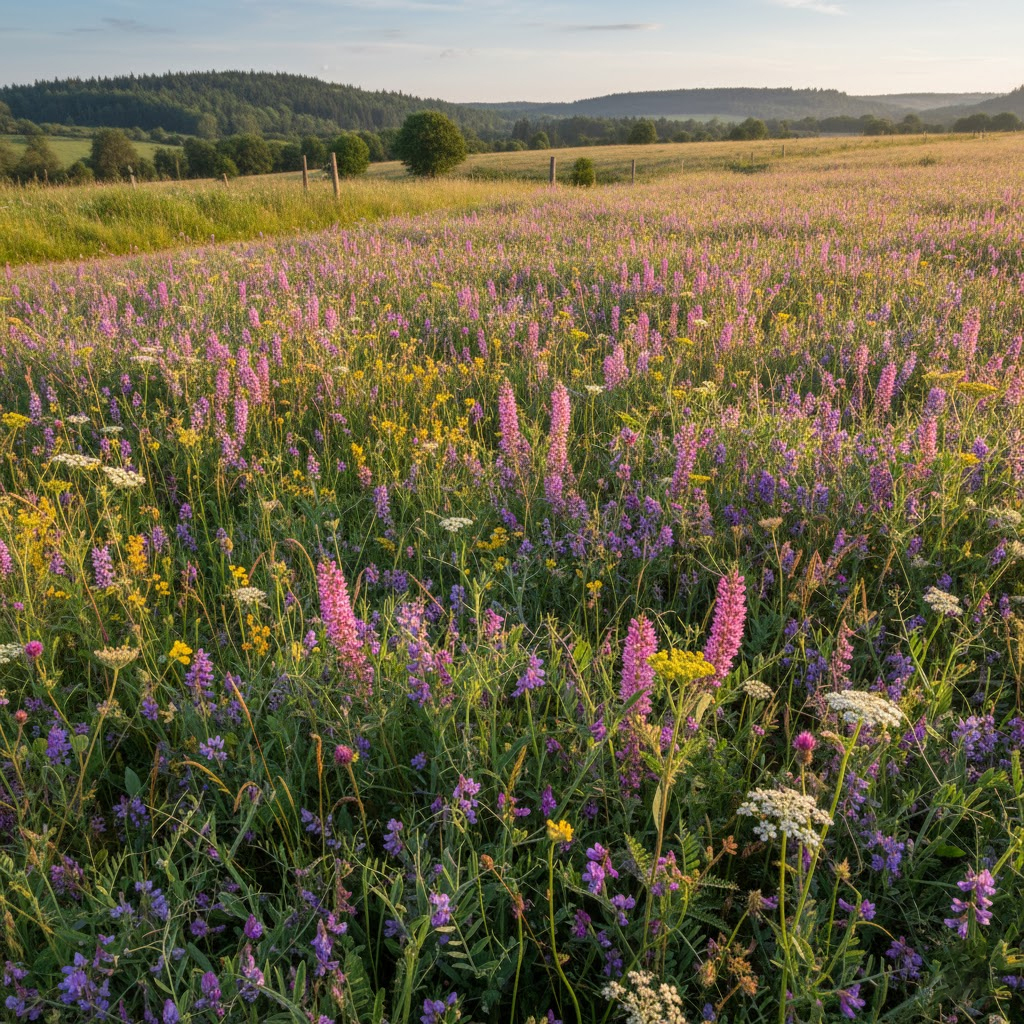
Starting at £8.45
Please Note; These mixes are intended for farmers and land managers, rather than home gardens. As such, it is not possible to mix in smaller quantities and is intended to be sold, to cover acres and hectares. If you do require smaller amounts, please Email us first on info@budgetseeds.co.uk.
Option 1 £10.45 per Kg (inc. VAT)
Sowing; 15-20Kg per hectare
50.00% Common Vetch 30.00% Sainfoin, 5.00% Birdsfoot Trefoil, 5.00% Yellow Trefoil, 5.00% Yarrow, 2.50% Knapweed, 2.50% Wild Carrot
Option 2 £35.49 per Kg (inc. VAT)
Sowing; 15-20Kg per hectare
20.00% Sainfoin, 10.00% Birdsfoot Trefoil, 10.00% Knapweed, 10.00% Musk Mallow, 5.00% Oxeye Daisy, 10.00% Wild Carrot, 5.00% Yarrow, 30.00% Common Vetch
Option 3 £8.45 per Kg
Sowing Rate; 15-20Kg per hectare
30.00% Vetch 20.00% Sainfoin, 10.00% Red Clover, 10.00% Linseed, 2.50% Yellow Blossom Clover, 1.00% Yarrow, 0.50% Ox-Eye Daisy, 0.50% Musk Mallow, 0.50% Knapweed 0.50%Wild Carrot, 10.00% Birdsfoot Trefoil, 10.00% Yellow Trefoil, 4.50% Buckwheat
3 years
£739 per hectare (ha) per year
This action’s aim is that there’s an established pollen and nectar flower mix which:
The purpose of this is to:
You can do this action on agricultural land located below the moorland line that’s:
This is a ‘limited area’ action. The total eligible area you enter into any combination of one or more of the ‘limited area’ actions must not be more than 25% of the total agricultural area of your farm. Read section 1.3 ‘SFI actions with a limited area’ in the SFI scheme information for more details (including a list of ‘limited area’ actions).
| Eligible land type | Eligible land cover | Compatible land use code |
|---|---|---|
| Arable land used to grow crops | Arable land | Land use codes for arable crops or leguminous and nitrogen-fixing crops |
| Temporary grassland | Arable land | TG01 |
| Arable land lying fallow | Arable land | FA01 |
| Permanent crops – horticultural | Permanent crops | TC01 |
| Protected land | Eligibility |
|---|---|
| Sites of special scientific interest (SSSIs) | Eligible – you must get SSSI consent before you do this action (read section 10.3 ‘SSSI consent’ in the SFI scheme information to find out how to do this) |
| Historic and archaeological features | Eligible – you must get a SFI HEFER before you do this action (read section 5.6 ‘Land with historic or archaeological features’ in the SFI scheme information to find out how to do this) |
Part of the available area in a land parcel.
This action is rotational or static. This means you can either:
You must establish a nectar flower mix as a block or strip on land entered into this action.
You must use a grass-free seed mix which includes at least 6 flower species, with no individual species being more than 50% of the total mix by weight.
The seed mix must include at least 2 of the following flower species:
Once the pollen and nectar flower mix block or strip is established (usually from the second spring after sowing), you must maintain it. To do this, you must manage it in a way that can reasonably be expected to achieve this action’s aim.
You must not do the following on the established pollen and nectar flower mix block or strip:
You can maintain an existing pollen and nectar flower mix block or strip to get paid for this action if it:
You must:
It’s up to you how you do this action, as long as you:
You may find it helpful to read the ‘advice to help you do this action’, but it’s not part of this action’s requirements.
You must keep evidence to show what you’ve done to complete this action, such as:
If it’s not clear that you’ve done this action in a way that could reasonably be expected to achieve its aim, we may ask for this evidence. You must supply the evidence if we ask for it.
You can do the following actions or options on the same area in a land parcel as this action.
Some actions or options can only be done on the same area if they’re done at a different time of year to this action. For example, winter cover followed by a summer companion crop. Read ‘What to do’ and ‘When to do it’ to find out when this action must be done.
| Scheme | Action or option codes |
|---|---|
| SFI 2024 actions | OFC3, OFC4, OFC5, OFM4, OFM5, OFM6, AGF1, AGF2, PRF2, CIPM1, CNUM1, CSAM1 |
| SFI 2023 actions | IPM1, NUM1, SAM1 |
| CS options | OR3, OR4, OR5, OT3, OT4, OT5 |
| ES options | No ES revenue options |
| SFI pilot standards | No area-based SFI pilot standards |
If an action or option cannot be located on the same area, you may be able to do it on a different area in the same land parcel. Read section 6 ‘Eligible land in other funding schemes’ in the SFI scheme information for more details.
You can do the following actions or options on the eligible boundaries of a land parcel entered into this action:
The following advice may help you to do this action, but it’s not part of this action’s requirements.
This action explains the minimum requirement for flower species in the seed mix (under ‘What to do’).
To help you achieve this action’s aim, you can use a seed mix containing shorter-living legumes and longer-living wildflower species.
You can choose to sow a seed mix containing more flower species than this action requires. Using an enhanced mix can be beneficial as it retains more flower species for longer and is likely to mean less frequent re-sowing. It can also help to provide a more varied mix of flowers for beneficial insects.
A seed supplier can help you choose a seed mix that’s the best match for your land and local conditions.
When you establish the pollen and nectar flower mix, by law you cannot cultivate or apply fertilisers or pesticides to land within 2m of the centre of a hedgerow. Read the guidance on Hedgerow management rules; buffer strips to understand how these rules apply to you.
It will usually help if you sow the pollen and nectar flower mix block or strips on sites that:
You can choose to locate the pollen and nectar flower mix blocks or strips on areas:
To provide a buffer zone for beneficial insects when fields are being sprayed, you can use:
To help beneficial insects (such as pollinators and crop pest predators) find food, you can have a number of blocks or strips spaced as evenly as possible across your land. For example, you could space 5 blocks or strips of 0.5ha evenly across 100ha.
Your seed supplier can advise you on an overall sowing rate for the seed mix you choose. This will usually be between 10kg (for light and medium soils, and land with limited fertility) and 20kg (for heavy soils and areas with a higher nutrient status).
You can help seeds germinate if you sow into a seedbed that’s:
If you sow in the autumn, try to sow before frosts and prolonged wet weather. You can get advice from the seed supplier on frost hardy annuals you could use in your seed mix.
Before you sow each block or strip, it will help if you mix the seed well. You can either:
If your seed mix contains larger seeds (such as common vetch and sainfoin), you could sow these first to a depth of 2cm and then sow the rest of the mix later.
After you have sown the seed mix, you can roll the seeds (if the soil is dry enough) to improve:
During the first spring and summer after sowing, it’s advisable to check the block or strip regularly to monitor germination. If establishment is poor, you may need to re-sow all or part of it. Your seed supplier can help you if you’re unsure what to do.
During the first 12 months have sowing, you can cut emerging flowers and weeds. This can help to control weeds, so the sown plants can establish.
It’s advisable to cut at a height which removes the top growth of any weeds to avoid:
If your mix includes early flowering annuals (such as black medick, common vetch, crimson clover or phacelia), it’s advisable to cut either:
Once the block or strip is established, this action requires you to maintain it by managing it in a way that can reasonably be expected to achieve this action’s aim.
To help you achieve this action’s aim, you can:
Once the block or strip has finished flowering, you can choose to:
Where you have left areas uncut or ungrazed over the winter months, you can cut or lightly graze them in the spring (usually March) before the flowers have started to grow. This can help to stop grass weeds from growing.
If you’re cutting the block or strip:
| Mix | Option 1 per Kg | Option 2 per Kg | Option 3 per Kg |
|---|
I have just bought all my new seeds for next year’s vegetables after having such great results this year. Budget seeds are so helpful, I’m a newbie in the veg growing world and they have been helpful in choosing the best seeds to start with etc. also much cheaper than elsewhere so if I do mess up in the future it isn’t costing me so much. I thoroughly recommend Budget Seeds for all your veg and flower seeds.
Mrs Morris