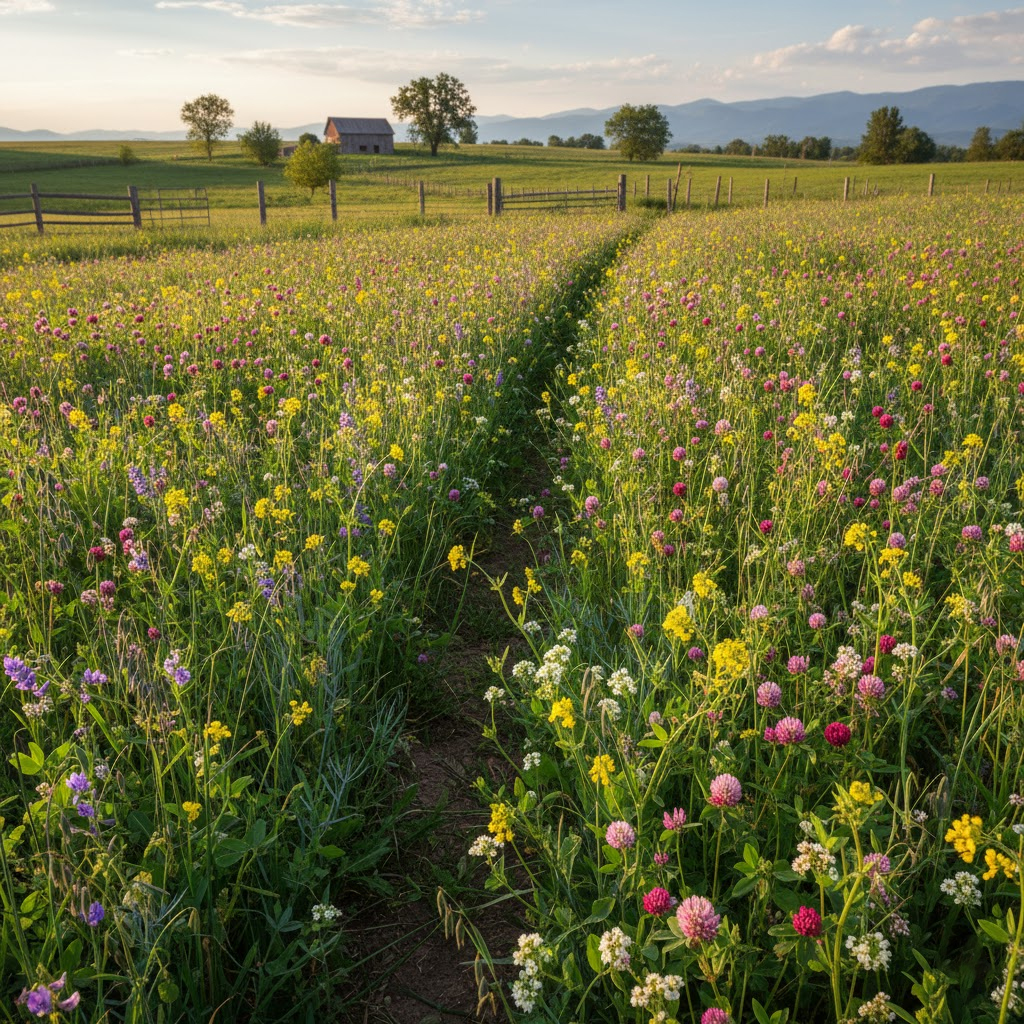
Starting at £3.65
Please Note; These mixes are intended for farmers and land managers, rather than home gardens. As such, it is not possible to mix in smaller quantities and is intended to be sold, to cover acres and hectares. If you do require smaller amounts, please Email us first on info@budgetseeds.co.uk.
Option 1 £3.65 per Kg
Sowing; 20Kg per hectare
50% Black Oats, 30% Common Vetch, 15% White Mustard, 5% Crimson Clover
Option 2 £3.70 per Kg
Sowing; 25Kg per hectare
50% Common Vetch, 30% Linseed, 10% Buckwheat, 10% Berseem Clover
Option 3 £3.75 per Kg
Sowing Rate; 25Kg per hectare
40% Common Vetch, 30% Sainfoin, 10% Berseem Clover, 10% Buckwheat, 10% Fenugreek
3 years
£163 per hectare (ha) per year
This action’s aim is that there’s a well-established summer-sown multi-species cover crop which is present between harvesting a cash crop, until either:
The purpose of this is to:
You can do this action on agricultural land located below the moorland line that’s:
| Eligible land type | Eligible land cover | Compatible land use code |
|---|---|---|
| Arable land used to grow crops, excluding temporary grassland | Arable land | Land use codes for arable crops or leguminous and nitrogen-fixing crops |
| Arable land lying fallow | Arable land | FA01 |
| Horticultural permanent crops | Permanent crops | TC01 |
| Protected land | Eligibility |
|---|---|
| Sites of special scientific interest (SSSIs) | Eligible – you must get SSSI consent before you do this action (read section 10.3 ‘SSSI consent’ in the SFI scheme information to find out how to do this) |
| Historic and archaeological features | Eligible – you must get a SFI HEFER before you do this action (read section 5.6 ‘Land with historic or archaeological features’ in the SFI scheme information to find out how to do this) |
Total or part of the available area in a land parcel.
This action is rotational or static. This means you can either:
You must establish a multi-species cover crop mix during the summer months (usually between June and August) which will not be harvested as a cash crop.
A ‘cash crop’ means a crop grown to be harvested for commercial use.
You must use a rapid growing seed mix that contains at least 4 species. This must include 2 species from two or more of the following plant families:
The seed mix must not contain:
You must avoid growing deep rooted species on any area within a land parcel with historic or archaeological features identified in your SFI HEFER. Read section 5.6 ‘Land with historic or archaeological features’ in the SFI scheme information for more details.
You must maintain the multi-species cover crop in a way, and for a period of time, that can reasonably be expected to achieve this action’s aim.
For the purposes of this action’s aim, the cover crop will be well-established if there’s:
You must not do the following on the well-established cover crop:
When you destroy the cover crop, you should try to minimise risks such as compaction, poaching, soil runoff or erosion.
If something happens which means you cannot complete this action, you must tell the Rural Payments Agency about this in writing as soon as possible. For example, if there’s prolonged adverse weather. Read section 13.2: ‘What you must do if you cannot comply with your agreement’ in the SFI scheme information to find out how to do this.
You must not use the following to meet this action:
You can only use an existing multi-species cover crop to meet this action’s requirements if you overseed it. This includes a cover crop already paid for under an environmental land management scheme action, such as SOH2 (multi-species spring-sown cover crop).
You must do this action each year of its 3-year duration.
If this action’s start date means it’s too late for you to do this action, you must start doing it within 12 months of the action’s start date.
In the final year of this action’s duration, you must do this action until the next main crop is sown, or this action’s end date, whichever is earlier.
It’s up to you how you do this action, as long as you:
You may find it helpful to read the ‘advice to help you do this action’, but it’s not part of this action’s requirements.
You must keep evidence to show what you’ve done to complete this action, such as:
If it’s not clear that you’ve done this action in a way that could reasonably be expected to achieve its aim, we may ask for this evidence. You must supply the evidence if we ask for it.
You can do the following actions or options on the same area in a land parcel as this action.
Some actions or options can only be done on the same area if they’re done at a different time of year to this action. For example, winter cover followed by a summer companion crop. Read ‘What to do’ and ‘When to do it’ to find out when this action must be done.
| Scheme | Action or option codes |
|---|---|
| SFI 2024 actions | AHW6, OFA1, OFA6, OFC3, OFC4, OFM4, OFM5, AGF1, AGF2, PRF1, PRF2, PRF3, PRF4, SOH1, SOH2, CAHL2, CIPM1, CIPM3, CIPM4, CNUM1, CSAM1, CSAM2 |
| SFI 2023 actions | AHL2, IPM1, IPM3, IPM4, NUM1, SAM1, SAM2 |
| CS options | AB2, AB9, HS3, HS9, SW5, SW6, OP1, OP5, OR3, OR4, OT3, OT4 |
| ES options | No ES revenue options |
| SFI pilot standards | No area-based SFI pilot standards |
If an action or option cannot be located on the same area, you may be able to do it on a different area in the same land parcel. See section 6 ‘Eligible land in other funding schemes’ in the SFI scheme information for more details.
You can do the following actions or options on the eligible boundaries of a land parcel entered into this action:
The following advice may help you to do this action, but it’s not part of this action’s requirements.
If you’re doing this action on land used to grow permanent horticultural crops, you can plant cover crops:
This action explains the minimum requirement for species in the seed mix (under ‘What to do’). Table 1 shows examples of what you could use.
| Plant family | Species |
|---|---|
| Brassicas | Yellow mustard, brown mustard, oil radish, tillage radish, stubble turnip, kale |
| Legumes | Common vetch, hairy vetch, red clover, white clover, alsike clover, sweet clover, crimson clover, lucerne, black meddick, peas and beans |
| Cereals or grasses | Italian ryegrass, festulolium, black oats, forage rye, barley, winter triticale |
| Herbs | Phacelia, buckwheat, linseed |
Choosing a varied mix (with multiple species from different plant families and with different characteristics) will normally bring greater benefits to your soil.
If you’re in an area with a shorter growing season, you may need to choose plants that germinate and grow in cooler weather.
Your seed supplier can help you choose a seed mix that’s the best match for your land and local conditions.
You may find it helpful to read the Agriculture and Horticulture Development Board (AHDB) information sheet about cover crops.
When you establish the cover crop, by law you cannot cultivate or apply fertilisers or pesticides to land within 2m of the centre of a hedgerow. Read the guidance on Hedgerow management rules: buffer strips to understand how these rules apply to you.
Your seed supplier can advise you on an overall sowing rate for the seed mix you choose.
You can drill or broadcast the seed mix. Drilling seeds is usually more reliable and gives a higher germination success than broadcasting. However, broadcasting is cheaper.
After you have sown the seed mix you can roll the seeds if the soil is dry enough. This can help to:
The cover crop will usually provide the most benefits to your soil if you maintain it for a period of at least around 8 consecutive weeks. However, this may differ depending on your crop rotation and geographical location.
If you’re destroying the multi-species cover crop, you can choose what method you use.
You can increase the benefits to soil of cover crops by combining them with:
| Mix | Option 1 per Kg | Option 2 per Kg | Option 3 per Kg |
|---|
I have just bought all my new seeds for next year’s vegetables after having such great results this year. Budget seeds are so helpful, I’m a newbie in the veg growing world and they have been helpful in choosing the best seeds to start with etc. also much cheaper than elsewhere so if I do mess up in the future it isn’t costing me so much. I thoroughly recommend Budget Seeds for all your veg and flower seeds.
Mrs Morris