£2.50 Shipping Per Order Of Seed Sachets/Packets With No Limit on Quantity • FREE Collection From Our Darlington Warehouse

Sedum Acre Potted Plant

Starting at £3.99

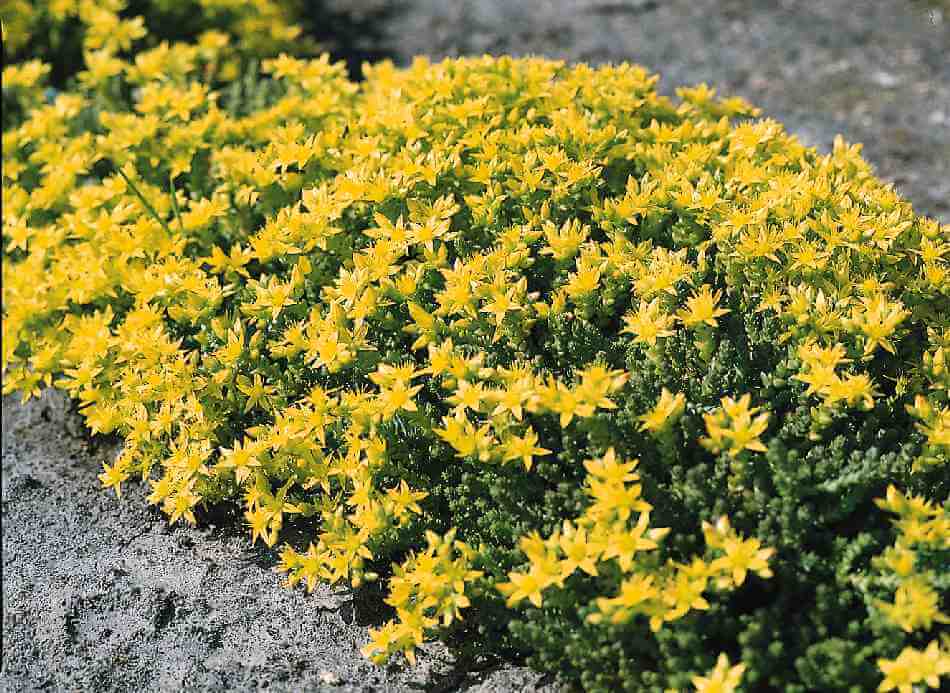
Sedum acre, commonly known as gold-moss stonecrop or biting stonecrop, is a tiny, creeping succulent that forms low, evergreen mats. It’s native to Europe and parts of western Asia, and has become naturalized in North America. It’s often used as a drought-tolerant groundcover on sunny, well-drained sites.

What it looks like

  • Growth habit: a mat-forming plant typically 1 to 4 inches tall, spreading 1–3 feet or more in favourable conditions. Leaves are tiny, fleshy, conical, and tightly arranged along the stems. When in bloom, slender stems rise with small, star-shaped yellow flowers.
  • Leaves and flowers: the leaves are thick and overlapping, giving a scale-like look; flowers are bright yellow, in small clusters during the early to mid-summer. The foliage can take on red tinges in strong sun or cold weather.

Where and how to grow it

  • Light and soil: prefers full sun to part shade and grows best in well-drained, sandy or rocky soil. It tolerates poor soils and even coastal/salt spray conditions. This plant is a good choice for rock gardens, walls, green roofs, and as a ground cover in sunny beds.
  • Water and drainage: very drought-tolerant; avoid consistently wet or poorly drained conditions. In containers, use coarse, well-drained media.
  • Hardiness and habitat: hardy from about USDA zones 3a through 9b, so it’s suitable in a wide range of climates. In nature you’ll find it on rocky places, walls, and coastal habitats.

Care, spread, and cautions

  • Growth and maintenance: generally low-maintenance and can be quite vigorous in ideal conditions, spreading readily via shallow roots and stolons. It can be weedy or aggressive in some situations, so it’s easy to manage with regular edging or containment.
  • Pests/diseases: few problems beyond occasional slug/snail pressure; avoid overly wet soils to prevent issues.
  • Safety note: the plant’s leaves contain acrid sap and can cause skin irritation for some people; be careful handling, especially if you have sensitive skin.
  • Edibility: stems and leaves are technically edible in small amounts, but ingestion can cause stomach upset; not a common culinary plant.

Varieties and propagation

  • Cultivars: there are several cultivars with different leaf colour and growth habit, including ‘Aurem’, ‘Octoberfest’, and ‘Yellow Queen’.
  • Propagation: easy to propagate by division, leaf cuttings, or seeds. Leaves that fall can root to form new plants.

Common uses

  • Ground cover on sunny slopes, rock gardens, and between pavers; great for green roofs and container displays due to its drought tolerance and low height. It’s also used where salt tolerance is beneficial and in situations requiring minimal irrigation.

Supplied in 9cm pots

Useful Information

  • Use a shallow tray or pot to accommodate the fine root systems. For some varieties, cold stratification can help break seed dormancy and boost germination.
  • Stratification involves keeping seeds in a moist, cold environment—such as a refrigerator—for about 14 to 30 days before sowing. This simulates natural winter conditions the seeds would encounter outdoors.
  • Sedum seeds are extremely small, so they require a light-sensitive planting method. Do not bury them; surface-sow by scattering evenly over the prepared, moistened soil surface. Gently press the seeds into the soil with a flat object to ensure good seed-to-soil contact without covering them.
  • A fine layer of horticultural vermiculite can be added atop the seeds to maintain surface moisture while still letting light reach them. This top layer also helps suppress algae and reduces the risk of fungus gnats.
  • After sowing, water with a misting bottle or by bottom watering: place the tray in a shallow tray of water so the soil wicks moisture upward. Covering the tray with a clear plastic dome or plastic wrap helps maintain high humidity, which supports germination.
  • Post-sowing conditions should be carefully controlled to encourage germination, which typically occurs in about 14 to 21 days. Sedum seeds germinate best at warm conditions, ideally a steady 65–72°F during this period. Because the seeds are photoblastic (they need light to sprout), using a dedicated grow light is often the most reliable approach.
  • Position grow lights about 3–4 inches above the soil surface and run them for roughly 16 hours each day. Once seedlings appear, gradually remove the plastic cover to improve air circulation and reduce the risk of damping-off fungi. Keep the soil consistently moist, but allow the surface to dry slightly between waterings. The seedlings will stay quite small for the first six to eight weeks.
  • Before moving the young Sedum outdoors, they should be hardened off. This involves gradually increasing hardening time: start by placing the trays in a sheltered outdoor spot for 30 minutes to an hour, then lengthen exposure each day over a week.
  • Seedlings are ready for final planting once the frost risk has passed and they have developed several true leaves. Sedum prefers a full-sun location (at least six hours of direct light daily) and well-drained soil.
  • When transplanting, dig a hole large enough for the root ball and place the plant so the top of the roots sits level with the surrounding soil. Space taller, clumping varieties up to about two feet apart, while low-growing, creeping types should be spaced about six to twelve inches apart to allow for spreading.

Additional information

Amount

1 plant | 2 plants | 3 plants | 5 plants

SKU N/A Categories , ,

We also recommend...