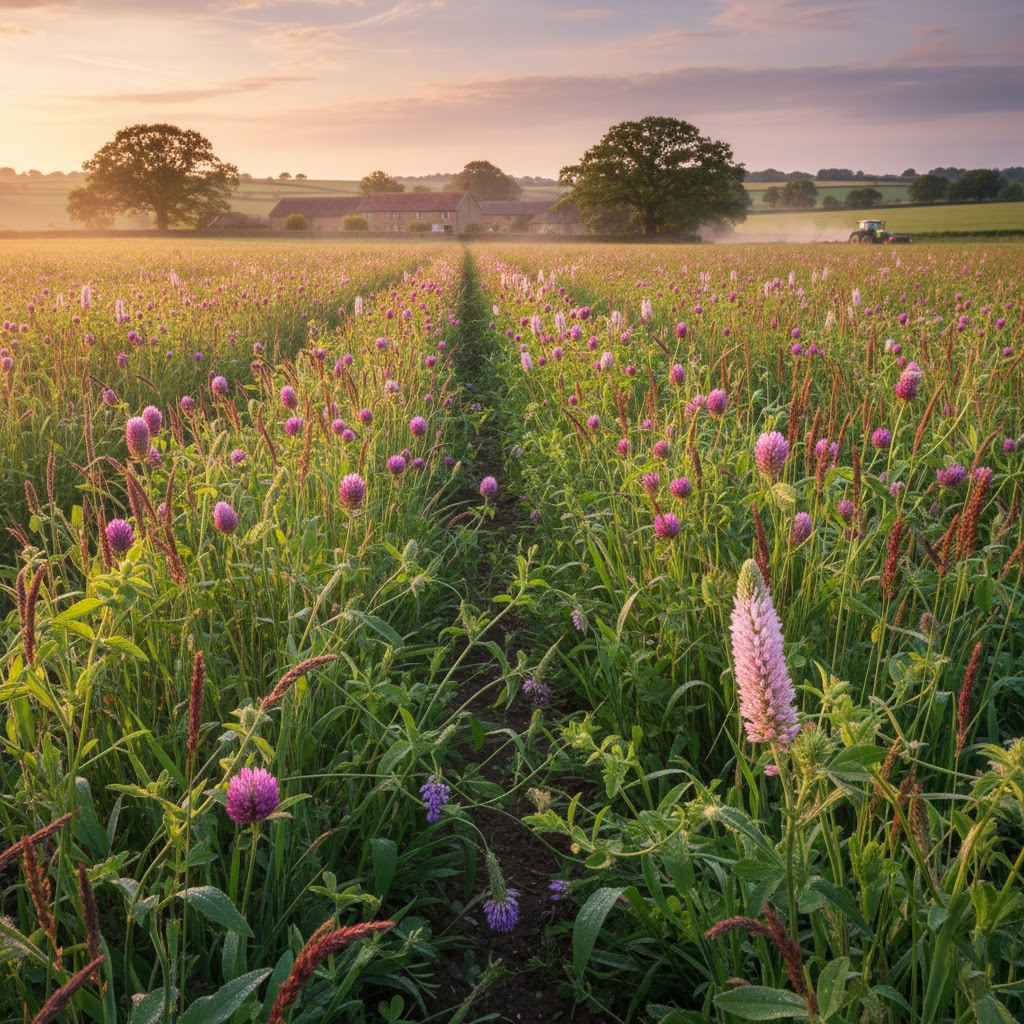
Starting at £4.35
Please Note; These mixes are intended for farmers and land managers, rather than home gardens. As such, it is not possible to mix in smaller quantities and is intended to be sold, to cover acres and hectares. If you do require smaller amounts, please Email us first on info@budgetseeds.co.uk.
Option 1 £4.55 per Kg
Sowing; 25-28Kg per hectare
25% Strong CRF, 20% Blida Early Dip PRG, 30% Gusto Int Dip PRG, 1% Ribgrass, 2% Chicory, 1% Sheeps Burnet, 8% Sainfoin, 3% Red Clover, 10% Common Vetch
Option 2 £4.45 per Kg
Sowing; 25-28Kg per hectare
25% Strong CRF, 20% Blida Early Dip PRG, 30% Gusto Int Dip PRG, 1% Ribgrass, 1.5% Sheeps Burnet, 10% Sainfoin, 2.5% Red Clover, 10% Common Vetch
Option 3 £4.35 per Kg
Sowing Rate; 25-28Kg per hectare
25% Strong CRF, 30% Blida Early Dip PRG, 20% Gusto Int Dip PRG, 1% Ribgrass, 2% Sheeps Parsley, 8% Sainfoin, 2% Red Clover, 12% Common Vetch
Option 4 Dry Soils £5.35 per Kg
Sowing Rate; 25-28Kg per hectare
35% Festulolium, 8% Timothy, 18% Strong CRF, 8% Cocksfoot, 5% SSMG, 15% Slender CRF, 2% Red Clover, 1% White Clover, 0.5% Rigbgrass, 1% Sheeps Burnet, 1% Lucerne, 5% Sainfoin, 0.5% Yarrow
Option 5 Standard Mix £7.20 per Kg
Sowing Rate; 25-28Kg per hectare
30% Int Dip PRG, 20% Meadow Fescue, 15% Strong CRF, 8% Timothy, 8% SSMG, 2% Red Clover, 10% Sainfoin, 2% Lucerne, 2% Birdsfoot Trefoil, 1% Sheeps Burnet, 1% Ribwort Plaintain, 0.5% Yarrow, 0.25% Wild Carrot, 0.25% Knapweed
3 years
£382 per hectare (ha) per year
This action’s aim is that there’s an established herbal ley with:
The purpose of this is to:
You can do this action on agricultural land located below the moorland line that’s:
| Eligible land type | Eligible land cover | Compatible land use code |
|---|---|---|
| Arable land used to grow crops | Arable land | Land use codes for arable crops or leguminous and nitrogen-fixing crops |
| Temporary grassland | Arable land | TG01 |
| Arable land lying fallow | Arable land | FA01 |
| Improved permanent grassland | Permanent grassland | PG01 |
| Protected land | Eligibility |
|---|---|
| Sites of special scientific interest (SSSIs) | Ineligible – you must not enter any area that’s designated as an SSSI into this action |
| Historic and archaeological features | Ineligible – you must not enter any area with an historic or archaeological feature into this action. This only affects the area where the feature is located in a land parcel. You can apply for this action on the remaining area in the land parcel if it’s eligible. |
Total or part of the available area in a land parcel.
This action is rotational or static. This means you can either:
You must establish an herbal ley with a mixture of grass, legumes and herbs on land entered into this action.
You must use a seed mix which includes all of the following (as a minimum):
If you’re establishing an herbal ley on land identified by you as being at risk of soil erosion or runoff, you must use establishment techniques which minimise the risk of soil erosion or runoff. You can use the soil management plan produced for CSAM1 (or SAM1) to identify this land. See action CSAM1 for more information.
Once the herbal ley is established, you must maintain it. To do this you must manage it in a way, and for a period of time, that can reasonably be expected to achieve this action’s aim.
You must minimise use of inorganic fertilisers containing nitrogen. Usually, this will be no more than around 40 kilograms (kg) of nitrogen per ha per year.
You must not use the established herbal ley for storage or apply pesticides on it, except:
You can maintain an existing herbal ley to get paid for this action if it:
You must:
It’s up to you how you do this action, as long as you:
You may find it helpful to read the ‘advice to help you do this action’, but it’s not part of this action’s requirements.
You must keep evidence to show what you’ve done to complete this action, such as:
If it’s not clear that you’ve done this action in a way that could reasonably be expected to achieve its aim, we may ask for this evidence. You must supply the evidence if we ask for it.
You can do the following actions or options on the same area in a land parcel as this action. Some actions or options can only be done on the same area if they’re done at a different time of year to this action. For example, winter cover followed by a summer companion crop. Read ‘What to do’ and ‘When to do it’ to find out when this action must be done.
| Scheme | Action or option codes |
|---|---|
| SFI 2024 actions | OFC1, OFC3, OFM1, OFM4, AGF1, AGF2, CIPM1, CNUM1, PRF1, PRF2, PRF3, CSAM1 |
| SFI 2023 actions | IPM1, NUM1, SAM1 |
| CS options | OR1, OR3, OT1, OT3 |
| ES options | No ES revenue options |
| SFI pilot standards | No area based SFI pilot standards |
If an action or option cannot be located on the same area, you may be able to do it on a different area in the same land parcel. Read section 6 ‘Eligible land in other funding schemes’ in the SFI scheme information for more details.
You can do the following actions or options on the eligible boundaries of a land parcel entered into this action:
The following advice may help you to do this action, but it’s not part of this action’s requirements.
This action explains the minimum requirement for species in the seed mix (under ‘What to do’).
If you want to grow a high-quality herbal ley (which goes beyond the basic requirements of this action), the seed mix will usually include at least:
Try to avoid a mix of festulolium and perennial ryegrass making up more than 70% by weight of the total seed mix.
Your seed supplier can help you choose a seed mix that is the best match for your land, local conditions and how you’ll manage the ley.
When you establish the herbal leys, by law you cannot cultivate or apply fertilisers or pesticides to land within 2m of the centre of a hedgerow. Read the guidance on Hedgerow management rules: buffer strips to understand how these rules apply to you.
You can maintain herbal leys by grazing them with livestock or cutting them (or both).
To help achieve this action’s aim, you can rest the herbal leys from grazing or cutting for around at least 5 consecutive weeks between early May and late July. This will allow flowers to open and provide a source of pollen and nectar for insects.
It can take up to 4 years for the roots to grow enough to improve soil structure and fertility.
You may find it helpful to read the Agriculture and Horticulture Development Board (AHDB) guidance on herbal leys.
| Mix | Option 1 per Kg | Option 2 per Kg | Option 3 per Kg | Option 4 per Kg | Option 5 per Kg |
|---|
I have just bought all my new seeds for next year’s vegetables after having such great results this year. Budget seeds are so helpful, I’m a newbie in the veg growing world and they have been helpful in choosing the best seeds to start with etc. also much cheaper than elsewhere so if I do mess up in the future it isn’t costing me so much. I thoroughly recommend Budget Seeds for all your veg and flower seeds.
Mrs Morris